
The independent heating and cooling company across Kentucky and the Ohio Valley
Ice on the Indoor Coil
You went to change the filter and found frost on the coil, or the air coming out of the vents went weak and warm while the outdoor unit kept running. Maybe there is water on the floor near the furnace. That is a frozen evaporator coil, and it means your AC is fighting something. Here is what causes it, what you can safely check, and what we do when we get there.
Call (888) 414-3292- A real person answers
- Open 7 days
- Written quote before work starts
Taking calls until 5:00 PM ET
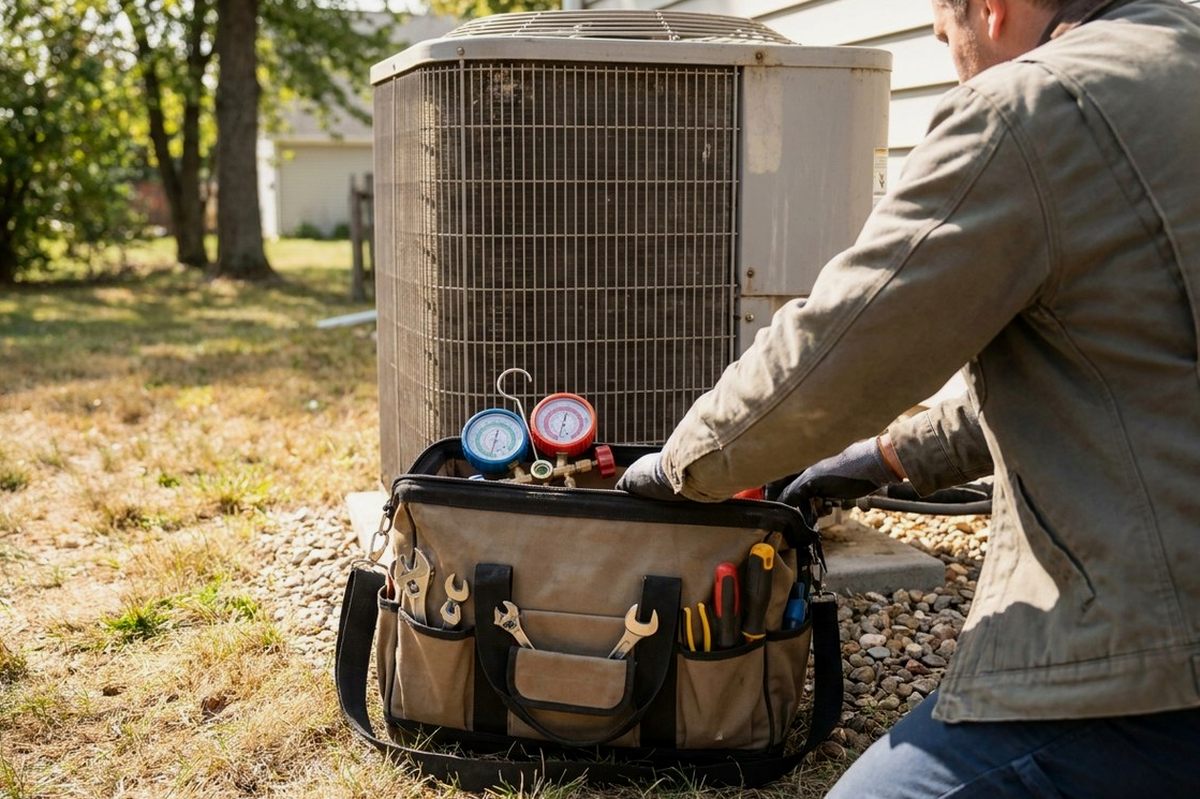
Derby City Comfort service team · field-reviewed before publishing
What Ice on the Coil Actually Means
The indoor coil gets cold on purpose. It only turns to ice when it cannot absorb enough heat from the air moving across it, so the refrigerant inside stays colder than it should and moisture on the coil freezes instead of draining away. Once a layer of frost forms, it blocks airflow further, which makes more frost. That is why a small problem turns into a solid block of ice in a few hours. The two broad reasons are always the same: not enough air over the coil, or not enough refrigerant in the system. Everything else is a version of one of those two.
Cause One: Airflow, and It Is Usually the Filter
Start with the cheapest and most common. A filter left in past its date, especially a thick pleated one in a home with pets, chokes the air the coil needs. Closed or blocked vents do the same thing, and so does furniture over a return grille. Older homes across the region often have undersized or crushed ductwork in a crawlspace, and a 1970s subdivision system may have a blower wheel packed with dust that no longer moves the air it was rated for. A dirty coil itself counts here too, since a mat of dust on the fins acts like a filter nobody changes.
Cause Two: Low Refrigerant, Which Means a Leak
If airflow is fine and the coil still ices, the system is likely low on refrigerant. Refrigerant is not consumed, so low means it leaked out, usually at a fitting, a coil fin, or the line set. Low charge drops the pressure in the coil, the temperature drops below freezing, and ice forms even with a clean filter. This is not a top-up-and-go situation. Adding refrigerant without finding the leak means you are back in the same spot next summer, and refrigerant work is not something a homeowner should attempt. It needs gauges, leak detection and recovery equipment.
Cause Three and Four: Blower and Controls
A failing blower motor or capacitor can spin the fan slower than it should, which starves the coil the same way a filthy filter does. On variable-speed setups, a bad control board or a wrong speed tap after a past service call causes the same result. Then there are controls: a thermostat set very low on a mild, humid night, a stuck contactor keeping the outdoor unit running, or a metering device that is not feeding the coil correctly. Running an AC when the outdoor temperature drops into the fifties will also frost a coil, which is worth knowing during shoulder seasons here.
What You Can Safely Check, and What We Do Differently
Turn the cooling off at the thermostat and switch the fan to ON. That lets room air melt the ice, which can take several hours. Put towels down, because it becomes water. While it thaws, change the filter, open every supply vent and return, and clear leaves and grass off the outdoor unit. Check the breaker if the system is dead. Do not chip at ice, do not touch refrigerant lines, and do not open the electrical compartment. When we arrive we measure static pressure and temperature split, read superheat and subcooling, check blower amp draw, and leak-search before we ever add refrigerant. That tells us which of the four causes you actually have. Call us and we will schedule the air conditioning repair.
When it is time to book
Ice on the Indoor Coil — what people ask
Can I just run the AC anyway until someone gets here?
No. Running it with a frozen coil pushes liquid refrigerant back toward the compressor, and compressor damage is far more expensive than the original repair. Turn cooling off, run the fan only, and let it thaw.
How long does it take to thaw a frozen coil?
With the fan running and cooling off, usually three to six hours. A solid block can take overnight. Keep towels or a shop vacuum nearby, since the drain pan may not handle all the meltwater at once.
If it was just the filter, will it freeze again?
If a filthy filter was the only cause, a fresh filter and open vents usually solve it. If it ices up again within a week or two with a clean filter, you likely have a refrigerant leak or a blower problem, and it needs an air conditioner repair visit.
How it works
- Step 1
Tell us the symptom
Call or fill in the quote form. We ask what changed, when it started, and what the thermostat reads. That short conversation tells us whether you need a visit today or tomorrow morning.
- Step 2
We diagnose on site
A technician checks the thermostat, the electrical side, airflow through the filter and ducts, and the equipment itself. We find the actual cause instead of swapping parts and hoping the noise goes away.
- Step 3
You decide before we work
We explain what failed, what the repair involves, and what we would do if it were our own house. Nothing gets replaced until you say go. Then we test the system before leaving.
- A real person answers
- Open 7 days
- Written quote before work starts
Why homeowners call us
- Old houses and new onesWe are used to century-old homes with retrofitted ductwork and 1970s subdivisions with original returns. Tight crawl spaces, low basement headroom and odd attic runs are normal parts of the day for us, not surprises that stall the job.
- Built for the swingsHumid summers push AC systems hard and January freezes expose weak igniters and cracked flues. We repair for both extremes across the region, so the fix holds when the weather turns instead of failing the first hard week.
- Air conditioning and heating bothAir conditioner repair in July, heating repair in January, and the IAQ and airflow problems that hide in between. One crew that knows how your cooling and heating share the same blower and the same duct system.
- Plain talk, no pressureWe tell you when a repair makes sense and when replacement is the honest answer. No scare tactics about your BTU load, no upsell scripts. You get the condition of the system and a clear next step.
- All major brands, gas & electricEvery major HVAC brand, gas and electric, handled by an independent crew.
- Straight answersIf a system is not worth repairing, we say so, often right on the phone.
About this guide
Safe checks done and it still misbehaves? That's a real fault
Report what you saw during the checks and we handle the rest. A minute to book.
- A real person answers
- Open 7 days
- Written quotes
- All major brands
- Gas & electric
Rather not call? Get a free quote →