
The independent heating and cooling company across Kentucky and the Ohio Valley
How Often a Filter Actually Needs Changing
You bought a filter, wrote the date on the cardboard edge, and then a year went by. It happens in every house we walk into. Here is the honest answer on how often a filter needs changing, what a clogged one actually does to your furnace and AC, and the signs it has already gone too far.
Call (888) 414-3292- A real person answers
- Open 7 days
- Written quote before work starts
Taking calls until 5:00 PM ET
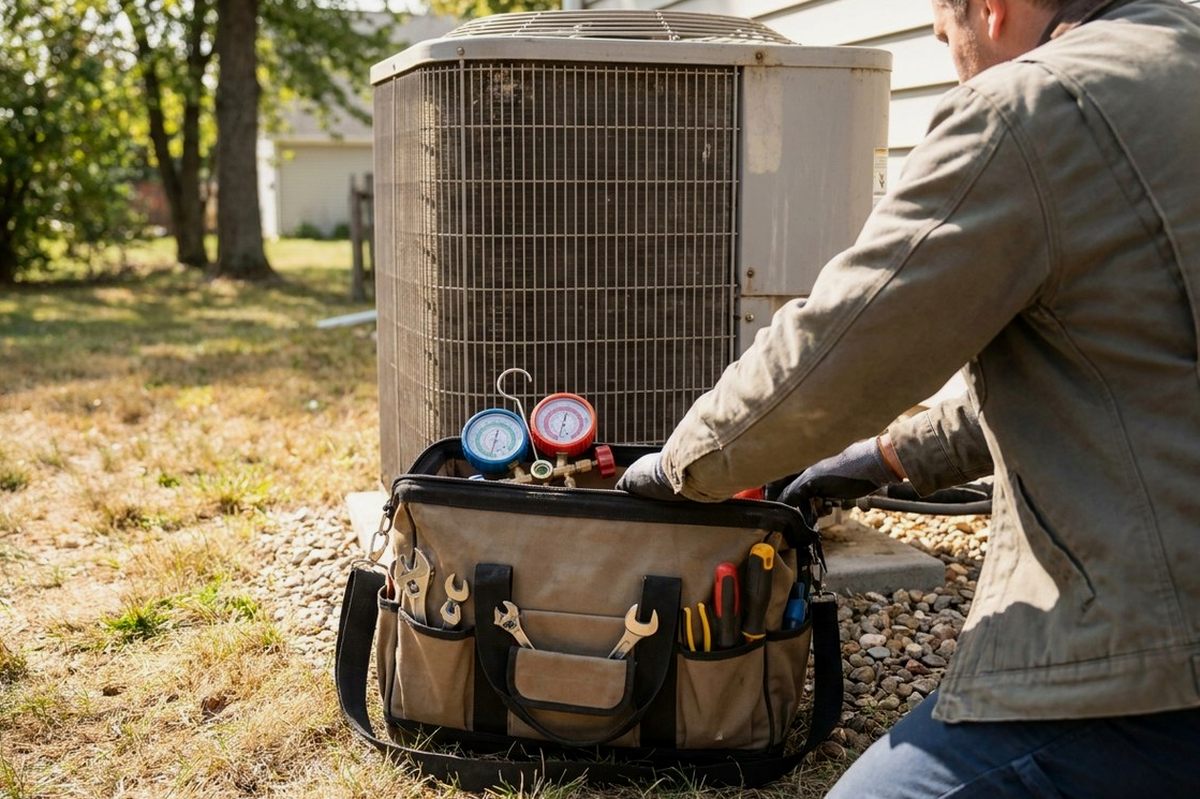
Derby City Comfort service team · field-reviewed before publishing
What a Neglected Filter Does Over Months and Years
A filter does not just get dirty and stop working. It keeps working, and that is the problem. As dust packs into the media, the blower has to pull harder through less open space. In heating season that means the furnace runs hotter than it was designed to and the high limit switch starts shutting the burners down early, so you get short cycles and cool air. In cooling season, low airflow across the indoor coil drops coil temperature until it frosts over, and a frosted coil moves no air at all. Over years, that added strain shows up as a tired blower motor and a compressor that has been working under bad conditions the whole time.
The Habit That Prevents Almost All of It
Pick a date you already remember and tie the filter to it. The first of the month, the day you pay a bill, whatever sticks. Buy filters two or three at a time and keep them near the unit so there is no trip to the store standing between you and the swap. Write the install date on the cardboard frame with a marker before you slide it in, because nobody remembers otherwise. Note the size printed on the old frame in your phone so you are not measuring in a dark basement. That is the whole system, and it prevents more service calls across our region than anything else a homeowner does.
How Often, Realistically
A one-inch pleated filter in an average home wants replacing every 60 to 90 days, and closer to 30 to 60 days when the system runs hard through a humid July or a long freeze. Thicker media filters, the four and five-inch cabinets, generally run six months to a year. Then adjust for what actually lives in your house. Two shedding dogs, indoor smoking, a gravel driveway, or a remodel with drywall dust can cut those intervals in half. Homes that sit empty part of the year stretch longer. Check it monthly by holding it up to a light. If you cannot see light through the pleats, it is done regardless of the calendar.
Warning Signs It Is Already Too Late
Weak air from the registers with the blower clearly running is the first one. Rooms farthest from the unit going warm in summer or cool in winter is the same problem showing up unevenly. Listen for a whistling or sucking noise at the return grille, which means the blower is starving. In heating, burners that light and then quit after a few minutes point to a limit switch tripping on heat buildup. In cooling, ice on the refrigerant line or water in the drain pan usually traces back to a frozen coil. A dusty smell when the system kicks on means air is bypassing a loaded filter. Change it, give it a few hours, and if nothing improves, call us.
When a Filter Change Is Not the Answer
Sometimes a fresh filter changes nothing, and that tells us something useful. Blocked or crushed return ducting, a blower wheel caked with dust, a failing capacitor, a dirty indoor coil, or low refrigerant all mimic the symptoms of a clogged filter. So does a thermostat set to the wrong mode. Before you call, you can confirm the thermostat batteries and settings, check for a tripped breaker, make sure supply vents in each room are open, and clear leaves and clippings back a couple of feet from the outdoor unit. Beyond that, gas, refrigerant and high-voltage work belongs with us. We handle air conditioning repair and heating repair for homeowners across Illinois, Indiana, Kentucky, Ohio, Tennessee and West Virginia.
Gas Smell or a Carbon Monoxide Alarm
If you smell gas or a carbon monoxide alarm sounds, get everyone out of the house first. Do not flip switches, do not go looking for the source. From outside, call 911 or your gas utility. Once they have cleared the building, call us and we will look at the furnace, the heat exchanger and the venting. A dirty filter can contribute to a furnace overheating and cycling badly, but a combustion or CO problem is never something to troubleshoot from inside the house. Life safety comes first, every time, and the diagnosis waits until the building is safe to be in.
How Often a Filter Actually Needs Changing — what people ask
Is a more expensive high-efficiency filter better for my system?
Not always. A dense filter in a system that was not designed for it restricts airflow the same way a dirty one does. Match the filter to what your equipment and ductwork can pull through, and change it on schedule.
Can I just vacuum the filter instead of replacing it?
No, on disposable pleated filters. Vacuuming pulls off surface lint but leaves the media loaded and can tear the pleats. Washable metal or electrostatic filters are made to be rinsed, dried fully, then reinstalled.
My filter looks clean after two months. Do I still change it?
If light passes through the pleats easily, you can leave it a while longer. Keep checking monthly. Filters in lightly used or empty homes genuinely last longer, so go by what you see rather than the calendar alone.
How it works
- Step 1
Tell us the symptom
Call or fill in the quote form. We ask what changed, when it started, and what the thermostat reads. That short conversation tells us whether you need a visit today or tomorrow morning.
- Step 2
We diagnose on site
A technician checks the thermostat, the electrical side, airflow through the filter and ducts, and the equipment itself. We find the actual cause instead of swapping parts and hoping the noise goes away.
- Step 3
You decide before we work
We explain what failed, what the repair involves, and what we would do if it were our own house. Nothing gets replaced until you say go. Then we test the system before leaving.
- A real person answers
- Open 7 days
- Written quote before work starts
Why homeowners call us
- Old houses and new onesWe are used to century-old homes with retrofitted ductwork and 1970s subdivisions with original returns. Tight crawl spaces, low basement headroom and odd attic runs are normal parts of the day for us, not surprises that stall the job.
- Built for the swingsHumid summers push AC systems hard and January freezes expose weak igniters and cracked flues. We repair for both extremes across the region, so the fix holds when the weather turns instead of failing the first hard week.
- Air conditioning and heating bothAir conditioner repair in July, heating repair in January, and the IAQ and airflow problems that hide in between. One crew that knows how your cooling and heating share the same blower and the same duct system.
- Plain talk, no pressureWe tell you when a repair makes sense and when replacement is the honest answer. No scare tactics about your BTU load, no upsell scripts. You get the condition of the system and a clear next step.
- All major brands, gas & electricEvery major HVAC brand, gas and electric, handled by an independent crew.
- Straight answersIf a system is not worth repairing, we say so, often right on the phone.
About this guide
Past the safe checks, it's a job for tools and a meter
Bring your notes from the checks to the call and booking takes no time.
- A real person answers
- Open 7 days
- Written quotes
- All major brands
- Gas & electric
Rather not call? Get a free quote →