
The independent heating and cooling company across Kentucky and the Ohio Valley
Is It Normal for a Heat Pump to Run All Day?
Your heat pump has been running almost without stopping since the cold snap started, and you are wondering if something is broken or if that is just what these systems do. Short answer: long run times in cold weather are often normal, but there is a line where normal turns into a problem. Here is how to tell the difference, and what to do next.
Call (888) 414-3292- A real person answers
- Open 7 days
- Written quote before work starts
Taking calls until 5:00 PM ET
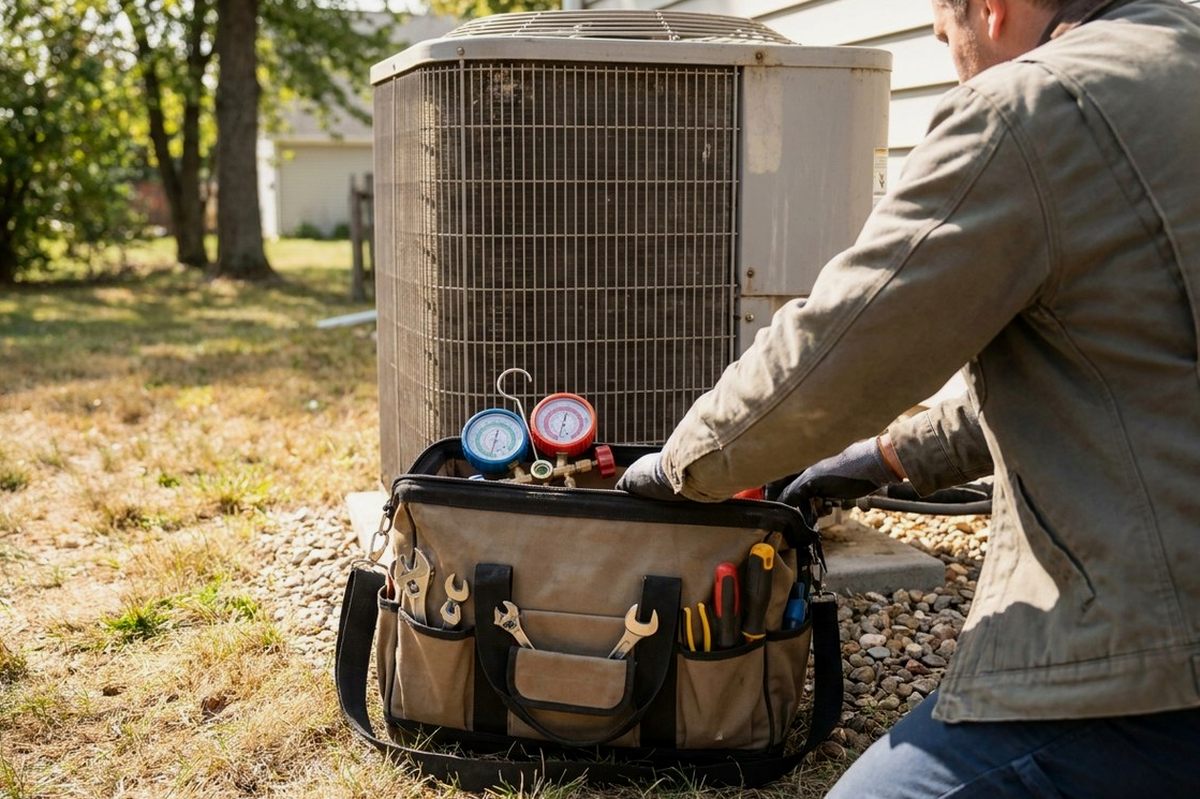
Derby City Comfort service team · field-reviewed before publishing
What Constant Running Actually Means in January
A heat pump moves heat rather than making it, so as outdoor temperatures drop it has to work longer to deliver the same warmth. On a day in the twenties, a correctly sized system may run for hours at a stretch and still hold your thermostat setting. That is design, not failure. The warning signs are different: the house keeps losing ground, the air from the vents feels cool, your auxiliary or emergency heat light stays on all day, or the outdoor unit is buried in ice and never clears it. Those point to a fault worth looking at across the region, and they are what we ask about first on a call.
Cause Family One: Airflow and Settings, the Cheap Stuff
Start with the things that cost the least to correct. A loaded filter chokes the indoor coil and forces long run cycles with weak, cool-feeling air. Closed or blocked supply vents do the same in reverse, especially in back bedrooms and finished basements. A thermostat left in emergency heat, or set several degrees higher than usual after a cold morning, will run the system hard for hours trying to catch up. Snow drifts, leaves, or a stack of firewood packed against the outdoor unit restrict the air it needs. We find one of these on a good share of nonstop-running calls, and they are the ones a homeowner can address safely.
Cause Family Two: Defrost and Refrigerant Problems
Outdoor coils frost up in cold, damp weather, and a healthy heat pump runs a defrost cycle to clear them. Steam off the outdoor unit for a few minutes is normal. A solid sheet of ice that never melts, or a unit that defrosts every fifteen minutes, means a failed defrost board, a bad sensor, or a reversing valve that is not switching. Low refrigerant from a leak shows up the same way: long run times, weak heat, ice where it does not belong. Refrigerant is not a homeowner repair and never a top-off without finding the leak. Call us and we will diagnose it properly.
Cause Family Three: Sizing, Duct Losses, and the House Itself
Sometimes the equipment is fine and the house is the problem. Older homes across Kentucky, Indiana, Ohio, Tennessee, West Virginia, and Illinois often have duct runs through unconditioned crawlspaces and attics, and a leaky trunk line can dump a third of your heat before it reaches a register. Undersized returns starve the blower. A heat pump matched to a house that has since had an addition, or one installed a size small to hit a number, will simply run out of capacity on the coldest days. We measure static pressure and temperature rise to separate a sizing issue from a repair, because the fixes are very different.
What Is Safe for You to Check, and What We Do Differently
Safe checks: put fresh batteries in the thermostat and confirm it is on heat rather than emergency heat, look for a tripped breaker, change the filter, make sure supply and return vents are open, and clear snow, leaves, and debris a couple feet back from the outdoor unit. Stop there. If you smell gas near any fuel-burning equipment or a carbon monoxide alarm sounds, leave the building first, call 911 or your gas utility, then call us. On our end we check refrigerant pressures and superheat, test the defrost control and reversing valve, read amp draw on the compressor, and measure airflow to find why it never catches up.
Related guides
Is It Normal for a Heat Pump to Run All Day? — what people ask
Is it bad for a heat pump to run all day?
Not by itself. Long, steady run times in cold weather are how heat pumps are meant to work. It becomes a problem when the house still will not reach temperature, the air feels cool, or auxiliary heat stays on constantly.
Why is my outdoor unit covered in ice?
Light frost is normal and clears during defrost cycles. Thick ice that stays for hours points to a defrost control fault, a bad sensor, or low refrigerant. Turn the system to emergency heat and call us for diagnosis.
Should I switch to emergency heat when it gets very cold?
Usually no. Emergency heat bypasses the heat pump entirely and runs the backup element, which costs more to operate. Use it when the heat pump has clearly failed or is iced solid, then schedule a heating repair visit.
How it works
- Step 1
Tell us the symptom
Call or fill in the quote form. We ask what changed, when it started, and what the thermostat reads. That short conversation tells us whether you need a visit today or tomorrow morning.
- Step 2
We diagnose on site
A technician checks the thermostat, the electrical side, airflow through the filter and ducts, and the equipment itself. We find the actual cause instead of swapping parts and hoping the noise goes away.
- Step 3
You decide before we work
We explain what failed, what the repair involves, and what we would do if it were our own house. Nothing gets replaced until you say go. Then we test the system before leaving.
- A real person answers
- Open 7 days
- Written quote before work starts
Why homeowners call us
- Old houses and new onesWe are used to century-old homes with retrofitted ductwork and 1970s subdivisions with original returns. Tight crawl spaces, low basement headroom and odd attic runs are normal parts of the day for us, not surprises that stall the job.
- Built for the swingsHumid summers push AC systems hard and January freezes expose weak igniters and cracked flues. We repair for both extremes across the region, so the fix holds when the weather turns instead of failing the first hard week.
- Air conditioning and heating bothAir conditioner repair in July, heating repair in January, and the IAQ and airflow problems that hide in between. One crew that knows how your cooling and heating share the same blower and the same duct system.
- Plain talk, no pressureWe tell you when a repair makes sense and when replacement is the honest answer. No scare tactics about your BTU load, no upsell scripts. You get the condition of the system and a clear next step.
- All major brands, gas & electricEvery major HVAC brand, gas and electric, handled by an independent crew.
- Straight answersIf a system is not worth repairing, we say so, often right on the phone.
About this guide
Checked everything on the list and it still acts up?
Report what you saw during the checks and we handle the rest. A minute to book.
- A real person answers
- Open 7 days
- Written quotes
- All major brands
- Gas & electric
Rather not call? Get a free quote →