
The independent heating and cooling company across Kentucky and the Ohio Valley
Heat Pump Repairs That Make Sense to Do
Your heat pump quit, or it runs and runs without getting the house comfortable, and somebody has already used the word "replace." We repair heat pumps across Kentucky, Indiana, Ohio, Illinois, Tennessee and West Virginia, and plenty of them are worth fixing. This guide walks through what we look at before we tell you either way, so the decision is yours and not a sales pitch.
Call (888) 414-3292- A real person answers
- Open 7 days
- Written quote before work starts
Taking calls until 5:00 PM ET
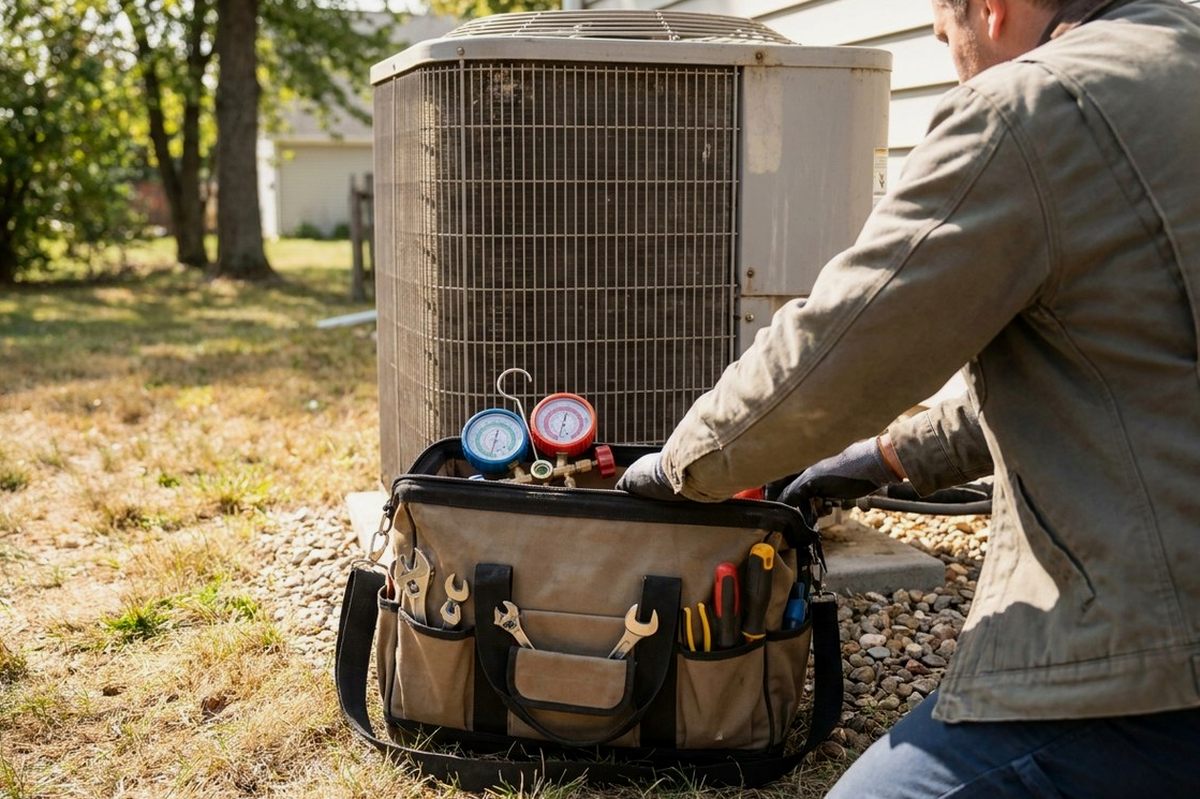
Derby City Comfort service team · field-reviewed before publishing
Age is a factor, not a verdict
A heat pump that has run through a decade of humid Julys and January freezes is not automatically finished. What matters more is how it was installed, whether it was ever cleaned, and how hard it has been working. We see units well past their expected years still holding temperature because the airflow was right and the refrigerant charge was correct from day one. We also see much younger systems failing early because they were oversized or short on return air. So when you ask us if yours is too old, our honest answer starts with a look at the equipment, not the date on the label.
The fault type tells you most of the story
Some failures are ordinary wear and worth repairing without much debate. Contactors, capacitors, defrost boards, reversing valve solenoids, fan motors and thermostats are all parts we swap regularly, and the system runs for years afterward. Other failures sit at the other end. A failed compressor, a leaking coil buried in the cabinet, or a refrigerant leak we cannot isolate changes the math because we are working on the heart of the unit. We diagnose first and tell you which category you are in. You should never have to guess whether you are buying a small part or most of a new system.
Parts availability and matched equipment
Repairs stop making sense when the part no longer exists. Older heat pumps and discontinued models sometimes need components that are back-ordered for weeks or simply gone, and in a hard freeze that wait is not livable. Refrigerant type matters too. Systems built for older refrigerants get harder to service as supply tightens. There is also the matching question. If your outdoor unit fails and your indoor coil and air handler are from a different era, a new outdoor unit alone can leave you with a mismatched set that never performs the way it should. We tell you when that is the situation.
How we think about it on the visit
We start with the actual complaint, then check the basics you can check yourself as well. Thermostat settings and batteries, a tripped breaker, a loaded filter, closed vents, debris packed against the outdoor unit. From there we measure. Temperature split, airflow, amp draw on the motors, and the electrical condition of the parts that commonly fail. We look at the cabinet and the coils for corrosion, and at the duct connections for obvious leakage. Then we explain what we found in plain terms, what the repair involves, and what we would expect from the system afterward. If there are two reasonable paths we lay out both.
Honest cases where replacement wins
Sometimes we tell people to stop repairing. A compressor failure on a system already showing coil corrosion and rusted-out cabinet is usually the end. Repeated refrigerant leaks in a coil that has been patched before will keep coming back. A unit that has needed three separate repairs in two seasons is telling you something. And if the equipment was badly sized or the ductwork never supported it, a new heat pump on the same setup repeats the problem, so we would rather fix the airflow and the sizing at the same time. We would rather tell you that once than take your money twice for the same fault.
Heat Pump Repairs That Make Sense to Do — what people ask
My heat pump blows cool air in winter. Is that a repair?
Often yes. Heat pumps deliver air cooler than a furnace does, which is normal, but genuinely cold air can mean a stuck reversing valve, a defrost control fault or low refrigerant. All three are diagnosable, and the first two are common repairs.
Should I repair one stage of the system if the rest is old?
It depends on how the pieces match. Replacing an outdoor unit while keeping a much older indoor coil often creates a mismatched system that underperforms. We check both sides before recommending a partial repair so you are not surprised later.
The outdoor unit is covered in ice. What should I do?
Turn the system to emergency or auxiliary heat if your thermostat has it, clear snow and leaves away from the outdoor unit, and call us. Occasional frost is normal during defrost cycles. A solid block of ice is not.
How it works
- Step 1
Tell us the symptom
Call or fill in the quote form. We ask what changed, when it started, and what the thermostat reads. That short conversation tells us whether you need a visit today or tomorrow morning.
- Step 2
We diagnose on site
A technician checks the thermostat, the electrical side, airflow through the filter and ducts, and the equipment itself. We find the actual cause instead of swapping parts and hoping the noise goes away.
- Step 3
You decide before we work
We explain what failed, what the repair involves, and what we would do if it were our own house. Nothing gets replaced until you say go. Then we test the system before leaving.
- A real person answers
- Open 7 days
- Written quote before work starts
Why homeowners call us
- Old houses and new onesWe are used to century-old homes with retrofitted ductwork and 1970s subdivisions with original returns. Tight crawl spaces, low basement headroom and odd attic runs are normal parts of the day for us, not surprises that stall the job.
- Built for the swingsHumid summers push AC systems hard and January freezes expose weak igniters and cracked flues. We repair for both extremes across the region, so the fix holds when the weather turns instead of failing the first hard week.
- Air conditioning and heating bothAir conditioner repair in July, heating repair in January, and the IAQ and airflow problems that hide in between. One crew that knows how your cooling and heating share the same blower and the same duct system.
- Plain talk, no pressureWe tell you when a repair makes sense and when replacement is the honest answer. No scare tactics about your BTU load, no upsell scripts. You get the condition of the system and a clear next step.
- All major brands, gas & electricEvery major HVAC brand, gas and electric, handled by an independent crew.
- Straight answersIf a system is not worth repairing, we say so, often right on the phone.
About this guide
When the easy checks change nothing, it's time for a tech
Report what you saw during the checks and we handle the rest. A minute to book.
- A real person answers
- Open 7 days
- Written quotes
- All major brands
- Gas & electric
Rather not call? Get a free quote →